
Skin lesions are incredibly common and can appear in various forms throughout life. Most are harmless, known medically as benign lesions, and while they don’t pose any danger to your health, they can sometimes be unsightly or cause self-consciousness.
Thankfully, treatments like CryoPen offer a quick, non-invasive way to remove them safely and effectively. Start your journey to clearer, healthier skin with Cryosonic Deal
Let’s explore what benign skin lesions really are, why they appear, and how the CryoPen treatment Deal has changed the way we manage them.
What Exactly Are Benign Skin Lesions – Should You Be Worried?
A benign skin lesion is a non-cancerous growth or irregularity on the skin. These can include spots, lumps, or patches that develop due to changes in skin cells, sun exposure, or ageing.
Unlike malignant (cancerous) lesions, benign ones don’t invade surrounding tissues or spread to other parts of the body.
Although they’re medically harmless, many people choose to have them removed for cosmetic reasons or to prevent irritation from clothing or shaving. Still, it’s always best to have a skin specialist assess any new or changing lesion before removal, to rule out anything suspicious.
What Causes Benign Skin Lesions to Develop Over Time?
Numerous factors, frequently a combination of them, can lead to the formation of benign lesions. The accumulation of pigmented or thickened areas can result from the gradual loss of our skin’s capacity to renew cells effectively as we age.
Another significant factor is sun exposure; ultraviolet (UV) rays can harm skin cells’ DNA, resulting in pigment abnormalities like age spots or solar lentigines.
Certain lesions, such as skin tags or seborrhoeic keratoses, can also be brought on by genetics, hormonal fluctuations, or even friction from jewellery or clothing.
In essence, they are a normal aspect of the skin’s deterioration with age, though depending on lifestyle and skin type, some people may experience more development than others.

How Can You Tell if a Skin Lesion Is Benign or Something More Serious?
The safest approach is always to get any lesion checked by a qualified professional—especially if it changes colour, shape, or size. Benign lesions are typically well-defined, uniform in colour, and slow-growing. They usually don’t cause pain, bleeding, or itching unless irritated.
On the contrary, an asymmetrical lesion with irregular borders and multiple colours extending rapidly in size may need investigation. However, usually before the assessment is done, dermatologists will use a dermatoscope to look at the lesion more closely and then confirm if it is benign and amenable to CryoPen removal in Deal.
Which Benign Skin Lesions Are the Most Common?
Numerous benign skin lesions can be effectively treated with CryoPen Deal, including:
Each of these lesions can be easily removed with CryoPen technology Deal, leaving no scars, cuts, or stitches behind.
Why Is the CryoPen a Skin Lesion Removal Revolution?
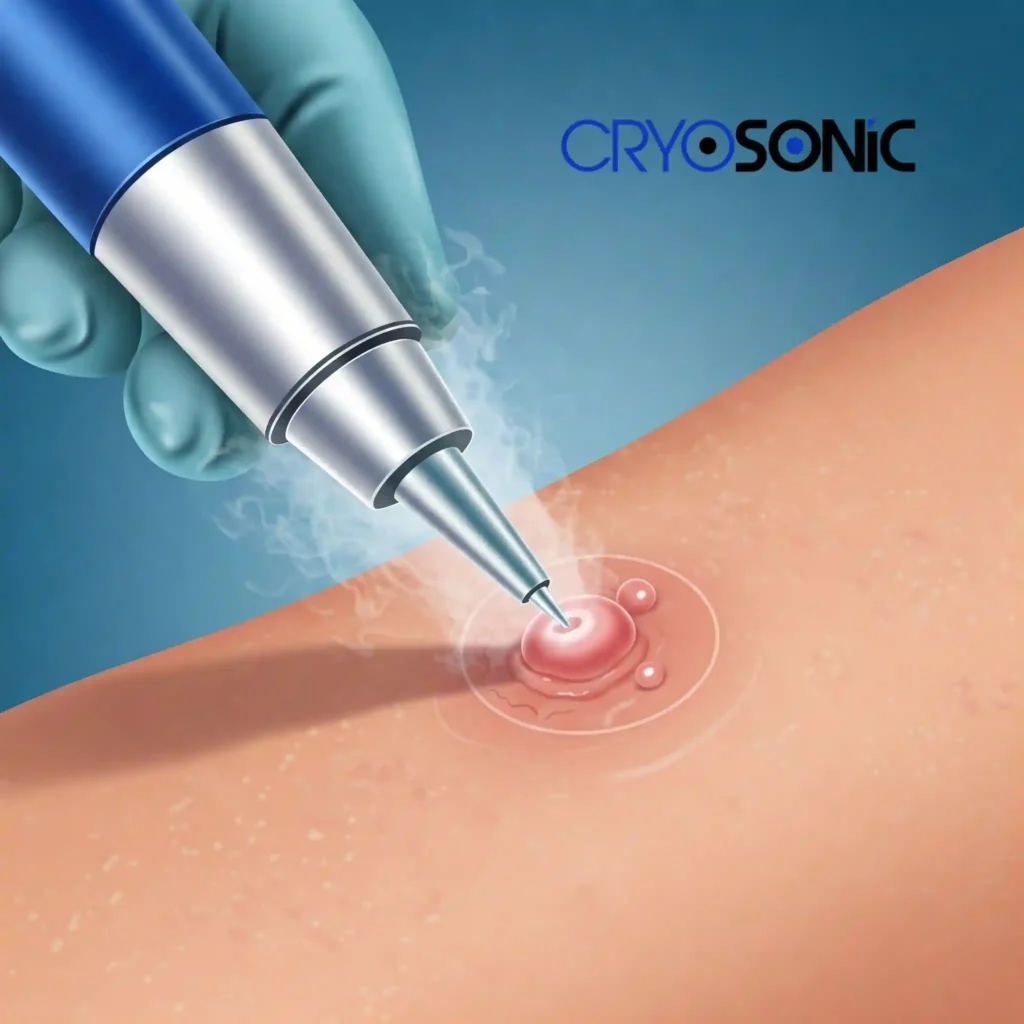
The removal of benign skin lesions by medical and cosmetic professionals has been transformed by CryoPen Deal. It freezes and kills the unwanted tissue by carefully applying extremely low temperatures with a pen-like device. Its accuracy, which enables it to target only the lesion while maintaining the surrounding healthy skin, is its most impressive feature. Discover how CryoPen works for age spots
It is the best choice for anyone looking for rapid, scar-free results because it is non-invasive, requires no anaesthesia, and requires no recuperation time. Because there are no open wounds or bleeding during treatment, it is also extremely hygienic and has a low risk of infection.
How Does the Comprehensive CryoPen Process Operate?
It usually only takes a few minutes to complete the easy and quick CryoPen procedure.
- Consultation: To ensure that the lesion is safe and appropriate for treatment, your practitioner looks it over.
- Cleaning and drying the area is the first preparation step. Since the procedure only causes mild discomfort, an anaesthetic is typically not required.
- Freezing: The lesion is directly exposed to a tiny jet of nitrous oxide, which freezes and kills the unwanted cells while protecting the surrounding skin.
- Healing: Within a week or two, the treated area may become darker or develop a tiny scab, but it will eventually fall off and reveal smooth new skin.
After the session, you can immediately resume your regular activities, and most people only experience a slight chill.

How long does it take for a cryopen procedure to show results?
The outcome may be slightly impacted by the lesion’s size and type. After a week or two, the treated area usually darkens a little before flaking or peeling off on its own. After it has healed, you’ll notice that the skin looks clearer, smoother, and more evenly toned.
Larger or deeper lesions may need a quick follow-up session or take a little longer to heal, but most people see great results after just one treatment.
FAQs Regarding CryoPen Therapy and Benign Skin Lesions
Q: What is a benign skin lesion?
A benign skin lesion refers to any type of noncancerous growth or mark that occurs on the skin. It may show as a lump, bump or patch but appears not to spread and does not represent any significant risk to health. For example, moles and age spots are really common forms of skin growths.
Q: Do benign lesions grow back after removal?
Most benign lesions do not come back once excised. But fresh ones can emerge later from the same sources of skin damage, such as ultraviolet light or simply ageing.
Q: Can benign lesions change in colour or shape over time?
Some may darken slightly or grow slowly with age, but sudden or dramatic changes should always be checked by a dermatologist to rule out anything serious.
Q: Are benign skin lesions hereditary?
Some types can run in families. For example, seborrheic keratoses and certain types of moles may appear more often if your parents or siblings have them.
Q: How can I tell if a skin lesion is benign or cancerous?
Benign tumours are usually border forms, homogeneous in colour and grow slowly. Cancerous ones can evolve quickly, with uneven edges and different colors. If in doubt and especially for new or changing lesions, see a skin specialist.
Q: Are all moles considered benign lesions?
Most moles are benign, but not all. Some may show early signs of melanoma. It’s important to keep an eye on any mole that changes shape, colour, or size.
For further information, please get in touch with us today at 03300 100 392